




Begin your journey to home AI driven HVAC comfort & Savings
Revolutionize HVAC Monitoring and Energy Efficiency
HVAIC begins the journey by collecting a myriad of data points typically many times each day for each season of the year. Data captured is internal from your HVAC equipment and external from the weather outside and environment related to your HVAC air handler.
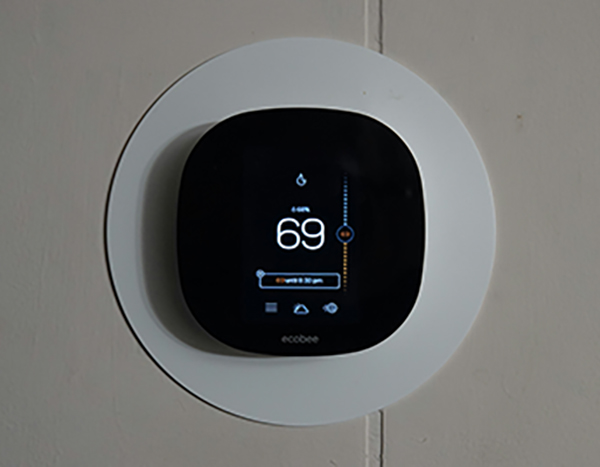
When sufficient data is captured in our cloud servers, it may then be AI processed for your individual home’s needs. The goal is to use AI to continually evaluate the daily dependencies of outdoor temperatures, HVAC operation and more to recommend, and with integrated devices such as wireless, smart thermostats, manage your HVAC for energy savings and more comfortable living.


Data directly from inside your HVAC Air Handler and Duct
Key Features of Monitoring Service
Air Filter Condition
- HVAIC monitors your air filter’s condition with our Differential Pressure sensor (DP).
- The DP measures air pressure on both sides of the air filter. As the filter becomes increasingly clogged, the pressure on the inlet side increases wile on the outlet side it decreases, due to less air passing through.
- Using a filter beyond its limits will force the fan to work harder to push the same amount of air through the system. This can increase the risk of expensive hardware failure.
- An email and/or text alert is sent to the owner when the pressure difference indicates an excessively dirty filter.
HVAC Air Output Temperature
- Which temperatures are saved to the cloud?
- In-Duct air after heated or cooled.
- Outdoor temperature at the time of in-duct measurement, and the forecasated highs and lows for that day.
- The ambient temperature at the HVAC air handler, such as an attic or basement.
- HVAIC monitors these temperature multiple times daily.
- The most important indicator of a current or future problem with an HVAC system is a continual shift in the temperature of its output air.
- Long term records of the relationship between the various temperatures provides valuable insights into the degradation of HVAC performance, and AI processing for energy saving actions or recommendations.
Energy Consumption
- HVAIC measures the amount of AC electrical current being used by your air handler. This provides relative data of total HVAC energy consumption by season and the temperature ranges.
- After sufficient historical data is obtained by HVAIC over each day of each season, AI analysis would be able to predict maintenance needs and provide insights into how best to set thermostats for energy reduction.
- Future plans for HVAIC include integration with one or more thermostat brands to automously adjust thermostats to “comfort zone” temperatures preferred by the home owners.
HVAC Run-Time & Energy
- In addition to energy, pressure, current and temperature, the run-time of the HVAC (the duty cycle) is stored with each data capture.
- Current and run-time do not provide KiloWatts of energy use, but relative energy use for each duty cycle. kW calculations require the voltage draw of each HVAC component. Each HVAC has uniqure voltage needs and are not available to HVAIC.
- Since the entire HVAC system never changes, its relative performance from day-to-day is what HVAIC tracks. Knowing the kW is not relevant to saving energy. Duty cycles are what determine the kW, thus HVAIC’s tracking highs, lows and average values represent whether your energy costs go up or down.
Heat Pumps
- Heat pumps become less energy efficient below about 40F.
- When it cannot maintain the set thermostat temperature, auxilary heating coils (AUX) active. A Google AI search shows that this can result in a 50% or higher energy usage.
- HVAIC’s monitoring of current can detect the higher current draw and thus track and report the times of use for AUX activation and its duration.
- An alert or report can be sent to the homeowner. The homeowner could then lower the thermostat setting at the times shown for AUX use to reduce the frequency and duration of its activation.
Outside Air Temperature
- Outside air temperature determines inside air temperature changes.
- Outdoor wireless thermometers are unreliable. Too often they are placed in areas where sun, heat loss from the home or heat from the outdoor HVAC unit influences the measured temperature.
- HVAIC records a weather service temerature for the home’s Zip Code whenever HVAIC sends duct air temperature to our cloud.
- Upcoming HVAC demand can be anticipated by the forecasted high and low temperatures of each day. As stated in the Energy Consumption tab, with sufficient historical data AI could use the forecasts to optimize HVAC functions to reduce the energy impact related to outdoor air temperature changes.
We help to get things completed reality.
Completed Projects
Qualified Engineers
Happy Clients
Years Experiance

High standard trsuted & professional services
We Provide Premium Cooling & Heating Services

Heating Services

Air Quality

Leak Detection

Condenser Coil
Filter Repair

Thermostat

Fan Repair
Request a quote for your work
Why do I need to change my filter regularly?
Lorem Ipsum at vero eos et accusamus et iusto odio digni goiku ssimos ducimus qui blanditiis praese. Ntium voluum deleniti atque corrupti quos iusto odio digni goiku ssimos ducimus.
How healthy is my indoor air?
Lorem Ipsum at vero eos et accusamus et iusto odio digni goiku ssimos ducimus qui blanditiis praese. Ntium voluum deleniti atque corrupti quos iusto odio digni goiku ssimos ducimus.
How often should I replace my filters?
Lorem Ipsum at vero eos et accusamus et iusto odio digni goiku ssimos ducimus qui blanditiis praese. Ntium voluum deleniti atque corrupti quos iusto odio digni goiku ssimos ducimus.
Trusted brands that we work with